
GHK-Cu vs Other Peptides: Which Injection Delivers Better Results for Tissue Repair?
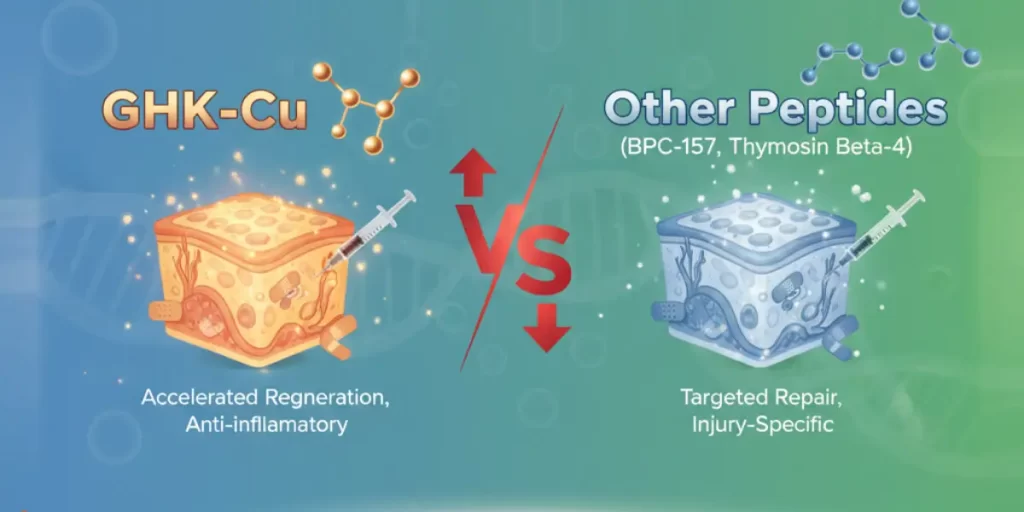
If you run a clinic, you are probably hearing more questions about peptides every month. Patients see a post about BPC-157 helping a torn tendon. A colleague swears by GHK-Cu for skin quality. Someone else mentions Thymosin Beta-4 after a sports injury. It can feel noisy fast. So when it comes to comparing either GHK-Cu vs BPC-157 or GHK-Cu vs Thymosin Beta-4 it all drills down to which offers better results.
This guide cuts through the noise for clinic owners. We will look at GHK-Cu, BPC-157, and Thymosin Beta-4 side by side with simple language, a practical comparison chart, and clear compliance context.
But one important compliance note before we began.
This article is for informational and procurement planning purposes for clinics only. It is not medical advice and it does not recommend diagnosis, treatment, or patient-specific care. As of now, there is no FDA-approved drug labeling for GHK-Cu, BPC-157, or Thymosin Beta-4 as injectable therapies for tissue repair in humans.
These peptides are not on FDA lists of bulk drug substances permitted for compounding for human use. Clinics should not stock or dispense non-approved sterile peptide injectables outside an appropriate investigational pathway.
BPC-157 and similar unapproved peptides are prohibited under the World Anti-Doping Code. Hence, if your patient base includes athletes, you need to be clear on this early.

About GHK-Cu
What it is?
GHK-Cu is a small, naturally occurring tripeptide that binds copper. Found in human plasma and skin. Well known in dermatology and aesthetics for topical use.
What it is studied for?
It is studied for wound remodeling, collagen support, skin quality, hair follicle signaling. Mostly cell and animal studies, plus some small human topical studies.
How it is usually used in practice?
Topical creams, serums, and sometimes as a cosmetic adjunct with micro needling. Injections for human tissue repair are not FDA approved.
About BPC-157
What it is?
BPC-157 is a synthetic Penta decapeptide derived from a protein sequence found in gastric juice.
What it is studied for?
In animals, it is studied for GI mucosal protection, tendon and ligament healing, bone repair, and neuroprotection. The data set is largely preclinical and comes heavily from a few research groups.
How do people usually use it in practice?
It has been sold on the gray market as an injectable or oral peptide. There is no FDA approval, and FDA has warned companies selling it for human use.
Thymosin Beta-4
What it is?
A natural actin-binding peptide involved in cell migration and tissue remodeling. The market features TB-500 as a synthetic fragment variant, while scientific literature discusses Thymosin Beta-4 as the parent peptide.
What it is studied for?
In animals, they are studied for cardiac repair signaling, corneal wound healing, dermal and muscle repair. In humans, there have been small trials of a Thymosin Beta-4 eye drop formulation for corneal healing. No FDA-approved injection indication.
How it is usually used in practice?
These are usually used in investigational studies. Any injectable use for tissue repair in humans is unapproved.
Peptide comparison chart: GHK-Cu vs BPC-157
Below is a simple side by side chart you can share with your team. It is designed to help you compare the profiles at a glance, not to guide patient care.
| Attribute | GHK-Cu | BPC-157 | Thymosin Beta-4 |
|---|---|---|---|
| Core signal | Copper-binding tripeptide linked to skin matrix remodeling | Gastric-derived pentadecapeptide with cytoprotective and angiogenic signals in animals | Actin-modulating peptide that promotes cell migration and tissue remodeling |
| FDA approval for injection in humans | No | No | No |
| Human clinical data relevant to healing | Limited human data, mostly topical cosmetic studies on skin appearance and wound appearance | No high quality randomized controlled trials in humans for musculoskeletal or GI healing | Small clinical studies with ophthalmic drops for corneal healing. Mixed results. No approved indications |
| Strongest preclinical signals | Skin remodeling, collagen and glycosaminoglycan synthesis, nerve outgrowth in models | Tendon and ligament healing, GI mucosal protection, bone healing in rodent models | Cardiac repair signaling post MI in animals, corneal wound healing, dermal repair in models |
| Common study route | Topical, intradermal in animals, ex vivo skin models | Intraperitoneal and oral in rodents. Various animal injection routes | Systemic and local injections in animals, ophthalmic drops in humans |
| Safety profile in regulated use | Widely used topically in cosmetics. No FDA-labeled safety data for injection | No FDA-labeled safety data. FDA has warned that products sold as BPC-157 are unapproved drugs | No FDA-labeled safety data for injection. Ophthalmic trials provide limited safety info for that route |
| Anti-doping issues | Not specifically listed, but always verify for athletes | Prohibited as an unapproved substance under WADA | Likely prohibited as an unapproved substance under WADA. Confirm for athlete patients |
| Regulatory practicality for clinics | Feasible for topical retail as a cosmetic ingredient with quality controls | Not feasible for compliant human injection use in clinics | Not feasible for compliant human injection use in clinics |
What does the evidence suggest about healing?
a) For GHK-Cu Peptide
The strongest support is in skin biology. In vitro and animal work shows increased collagen and elastin synthesis, improved wound appearance, and signals that support nerve outgrowth. Small human topical studies report improvements in skin firmness, elasticity, and photoaging markers. Clinical grade injection data for tissue repair are not available.
b) For BPC-157
The animal data are intriguing. Studies report accelerated tendon and ligament healing, improved bone repair, GI protection from NSAIDs, and neurovascular protection. That said, the human clinical evidence needed for standard of care is missing. Also note that much of the research is clustered within a small number of labs, which calls for independent verification.
c) Thymosin Beta-4
Preclinical studies suggest it encourages cell migration and angiogenesis, which are fundamental for repair. Ophthalmology has seen the most human work with a TB4 eye drop formulation in dry eye and neurotrophic keratopathy, with mixed but encouraging signals. Researchers have not proven or received approval for systemic injection for tissue repair in humans.
So which injection delivers better results for tissue repair?
Given today’s evidence and regulations, clinicians cannot recommend any of these peptides as injectable therapies for human tissue repair in a clinical setting. Not GHK-Cu. Not BPC-157 and Not Thymosin Beta-4. That is the compliance grounded answer.
If you are building a repair and recovery program today, align your protocols with FDA-approved therapies and well supported standards like physical therapy, PRP where permitted, shockwave for specific indications, appropriate surgical referral, and nutrition.
And, If you want to explore peptides, you should do so through an IRB-approved investigational study that uses GMP materials, includes data monitoring, and obtains full patient consent.
Which peptide suits your clinic’s goals
a) If your clinic focuses on skin quality, scar appearance, or cosmetic recovery
Consider GHK-Cu in topical form within a cosmetic program. It has a reasonable track record in skincare, it is familiar to patients, and it avoids the regulatory pitfalls of injections. Pair with microneedling or RF needling only within cosmetic scope and device instructions.
b) If your clinic focuses on musculoskeletal repair for athletes or workers
Be cautious with any peptide claims. For now, BPC-157 and Thymosin Beta-4 remain research topics, not clinical tools. Keep your reputation strong by leading with evidence based rehab, in clinic modalities, and referrals where needed.
c) If your clinic participates in research
This is where peptides can be explored. Define a precise indication, secure IRB approval, source GMP grade material with full certificates and sterility testing, pre register your study, and build a safety monitoring plan. Expect scrutiny and publish either way.
Advantages and Disadvantages of GHK-Cu vs BPC-157 and other Peptides
a) Evidence strength
GHK-Cu has the most human exposure but mainly as a topical cosmetic.
TB4 has some human data in eye drops, not injection.
BPC-157 has the most ambitious preclinical claims, but the human gap is large.
b) Regulatory fit
Only topical cosmetics with GHK-Cu are straightforward for clinics. The rest are not approved drug products for human injection
c) Safety and liability
Without FDA labeled dosing and safety, you carry the risk. Sterility, dosing variability, and impurities are real concerns with unapproved injectables.
d) Patient expectations
Patients may arrive with social media driven certainty. Clear, kind education preserves trust. Share what researchers know and acknowledge what they don’t. Offer proven alternatives.
Practical safety and quality checklist for any research use
You must always Source only from GMP compliant manufacturers with lot level certificates of analysis. Because they include identity by mass spectrometry, purity by HPLC, endotoxin testing, sterility, and residual solvents.
Confirm stability and storage data with real time and accelerated studies for the exact formulation and container.
Use USP grade excipients and validated sterile processes. Avoid multi dose vials unless antimicrobial preservatives and stability data support them.
Register an IRB approved protocol with detailed inclusion and exclusion criteria, dose exploration logic, and a stopping plan.
And report adverse events because transparency builds the field.
Talking with patients who ask about peptides
Acknowledge the interest. I hear this a lot. Peptides are a hot topic and there is some exciting lab research.
Set the boundary. The FDA has not approved any of the peptides you’re asking about as injections for healing. That means we do not offer them as treatments here.
Offer something solid. These options have proven to help your specific issue. We can also revisit clinical trials if you’re interested in research settings.
Leave the door open. We monitor this space closely and will let you know if high quality human data and approvals arrive.
Procurement note for clinic owners
If you operate within research frameworks and are comparing materials for protocol development, you may find it useful to review product specifications, certificates, and pricing options in one place. Compare & order GHK-Cu 50mg for your peptide protocol.
Frequently Asked Questions: GHK-Cu vs BPC-157
1. Are GHK-Cu and other similar peptides legal to inject in my clinic?
Not as FDA approved treatments for tissue repair. Using these injections in humans would be investigational and requires appropriate research oversight.
2. Can my compounding pharmacy make these for office stock?
In general, the FDA does not include these peptides on its lists of bulk drug substances permitted for human compounding under 503A or 503B, and it restricts the office use of non-approved sterile injectables.
3. Do sports authorities ban them for athletes?
BPC-157 and other unapproved peptides fall under WADA prohibited categories. Advise athlete patients accordingly.
4. What about topical GHK-Cu?
Cosmetic companies widely use GHK-Cu, but if they sell it as a cosmetic, they must not market it to diagnose, treat, or prevent disease. Follow cosmetic regulations and good manufacturing practices.
5. Will better human data arrive soon?
It is possible. Ophthalmology has been the most active area for TB4. Researchers must conduct and publish credible human trials before clinicians can adopt BPC-157 and GHK-Cu injections.
Bottom line for clinic owners
If the question is GHK-Cu vs BPC-157 or Thymosin Beta-4 for injection based tissue repair, the compliance grounded answer today is none of the above. And not enough FDA-approved human evidence supports using these injectables in routine care.
But if your goal is to serve patients safely and grow your clinic’s reputation, lead with approved therapies and transparent education. Consider GHK-Cu in topical cosmetic programs where it fits, and keep an eye on peer reviewed trials for the rest.
However, if your clinic is research active, build rigorous protocols, source quality materials, and publish your outcomes.
Disclaimers
This content is for educational purposes for healthcare businesses. It is not medical advice and not a recommendation to diagnose, treat, or cure any condition. You should always rely on FDA approved drug labeling and professional guidelines for patient care. Also, any research use must comply with federal and state law, IRB oversight, and good clinical practice.
Suggested Reading
What Clinical Studies Say About GHK-Cu Injections for Collagen Synthesis & Scar Reduction
GHK-Cu Injection Dosage Guide: Protocols, Frequency & Safe Administration for Medical Professionals
Procurement Guide for Clinics: How to Source High-Purity GHK-Cu Injections?
Storage, Stability & Handling of GHK-Cu Injections: Best Practices for Medical Facilities
ROI of Offering GHK-Cu Injections in MedSpas & Wellness Clinics
What Is GHK-Cu? A Clinician’s Guide for Skin Regeneration & Wound Healing