
Procurement Guide for Clinics: How to Source High-Purity GHK-Cu Injections?
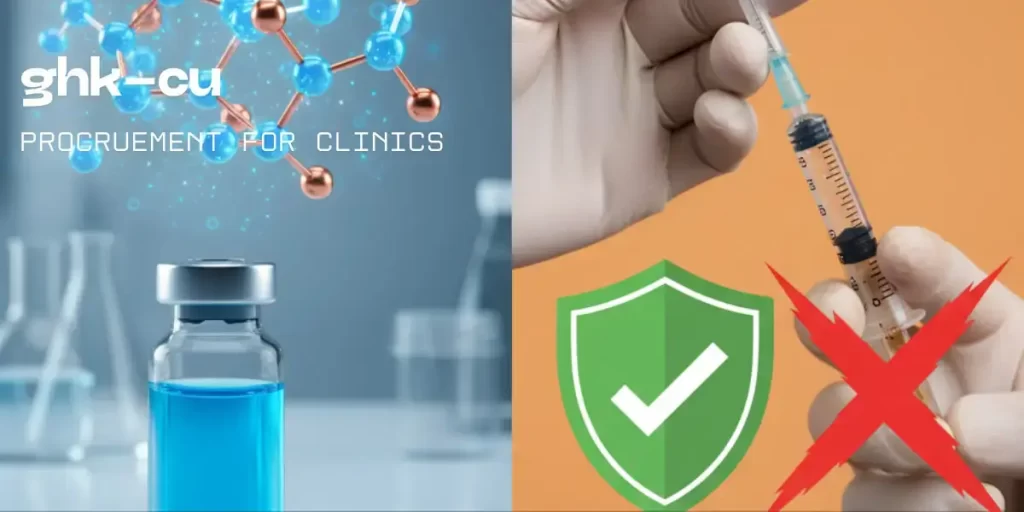
Let’s talk about something that doesn’t always get the spotlight it deserves i.e. how to buy GHK-Cu for clinics or source injectable peptides. Because you’re not just buying a vial. You’re investing in patient trust, clinical outcomes, and your clinic’s reputation.
Over the years, interest in this copper tripeptide has grown quickly. That said, buying it the right way is not simple. Between purity, sterile manufacturing, compounding rules, and storage logistics, there is a lot to get right. Therefore I wrote this guide to help clinic owners and medical directors navigate procurement with confidence.
What GHK-Cu is and why purity matters
GHK-Cu is the copper complex of the tripeptide glycyl-L-histidyl-L-lysine. You will also see it called copper tripeptide-1. In topical and research contexts, it is known for its copper-binding properties. For injectables, purity and sterility are everything. Even tiny amounts of endotoxin, residual solvents, or unbound copper can be a big problem in an injectable setting.
That is why the phrase medical grade GHK-Cu is not about marketing. It is about meeting strict analytical specifications, sterile processing controls, and fully traceable supply chains. If you are asking yourself where to buy GHK-Cu for clinics or how to find a GHK-Cu supplier in USA that is actually reputable, then this guide will walk you through a practical, clinic-friendly due diligence process.

Why Sourcing Matters More Than You Think
I once spoke with a clinic owner in Denver who bought “medical grade GHK-Cu” from a random online vendor because the price was 60 percent cheaper than everyone else. The product arrived fast. The packaging looked legit. But within two weeks, three patients reported unusual swelling and irritation at injection sites.
Turns out? The “GHK-Cu” was diluted with saline and contaminated with endotoxins. Lab tests later confirmed it wasn’t even close to the labeled concentration. The clinic had to issue refunds, file incident reports, and spend months rebuilding trust.
Don’t be that clinic.
High purity isn’t a luxury. It’s non-negotiable.
When you buy GHK-Cu for clinics, you’re not just purchasing a vial. You’re purchasing patient safety, clinical credibility, and peace of mind. So how do you make sure you’re getting the real deal?
How to Source High-Quality GHK-Cu Injections?
1. Start With the Certificate of Analysis (CoA)
Any legitimate GHK-Cu supplier USA based or otherwise will provide a Certificate of Analysis for every batch. Not “upon request.” Not “sometimes.” Every. Single. Batch.
The CoA should include:
- Exact concentration (e.g., 50mg/mL)
- Purity percentage (aim for 98% or higher)
- Tests for heavy metals, endotoxins, residual solvents
- Sterility confirmation
- Manufacturer lot number and expiration date
If they can’t produce this within 24 hours of your inquiry? Walk away.
2. Verify the Manufacturer, Not Just the Distributor
Many suppliers are middlemen. They don’t make the product — they just repackage and resell it. Nothing wrong with that, if they’re transparent.
But you need to know who actually manufactured the peptide. Ask for:
- The name and address of the manufacturing facility
- Their compliance certifications (GMP, ISO, FDA registered facility, etc.)
- Third-party audit reports if available
Bonus tip: Call the manufacturer directly. Yes, really. A five-minute phone call can save you five months of headaches.
3. Check for Proper Storage and Shipping Protocols
GHK-Cu is temperature-sensitive. If it’s shipped in a flimsy envelope during July across three states without cold chain logistics? You’re rolling the dice.
Ask your potential supplier:
- Do you ship with cold packs or dry ice?
- Is tracking included?
- What’s your policy if a shipment arrives compromised?
Reputable suppliers will guarantee their shipping process. Some even offer replacements if temperature logs show deviation.
4. Review Customer Service and Responsiveness
This sounds soft, but it’s critical. When you have a question at 6 PM on a Friday before a Monday morning patient, you need answers — fast.
Test them before you buy:
- Send an email asking for a sample CoA
- Call and ask about storage recommendations
- See how long it takes to get a human on the line
If they take 72 hours to reply or sound confused about basic handling? Red flag.
5. Compare Pricing — But Don’t Chase the Lowest Number
Yes, budget matters. But in injectables, the cheapest option is almost always the most expensive mistake.
How To Evaluate your GHK-Cu injection supplier?
Do a structured quality and compliance review. This is your best protection against low-quality suppliers.
1. Supplier-level checks before you buy GHK-Cu for clinics
a) FDA registration status
For 503B facilities, verify listing on FDA’s Outsourcing Facility list, current as of this year.
Review the facility’s last FDA inspection outcome. Look for absence of unresolved warning letters or consent decrees.
b) Quality system maturity
Ask for a quality overview: change control, deviation management, environmental monitoring, aseptic processing qualifications, media fills, and personnel training.
Request a sample quality agreement. A serious supplier will not hesitate.
c) Recall and complaint handling
Confirm written procedures for field alerts, recalls, and complaint investigations.
Ask whether they have had any sterile product recalls in the past three years and how those were remediated.
d) DSCSA compliance
Clinics receiving prescription drug products must receive transaction information, transaction history, and transaction statements. Ensure the supplier’s system is set up for you.
2. Product-level checks before you buy GHK-Cu for clinics
Insist on a complete certificate of analysis and accompanying reports for each lot. For a sterile GHK-Cu injection, expect the following at minimum.
a) Identity and purity
HPLC or UPLC purity, typically target greater than 98 percent for peptides, with impurity profile characterized
Mass spectrometry confirmation of molecular weight.
Amino acid composition or sequence confirmation where applicable.
b) Potency and assay
Quantitative assay of GHK-Cu content in the finished vial, not just in the starting powder.
Copper content verification and chelation stoichiometry if specified in the formulation.
c) Sterility and endotoxin
Sterility testing per USP <71>.
Bacterial endotoxin testing per USP <85>, with acceptance criteria aligned to parenteral administration.
d) Particulates and visual quality
Subvisible particulate testing per USP <788>.
Visual inspection results per USP <790>.
e) Physicochemical attributes
pH, osmolality, fill volume accuracy, and residual solvent testing per ICH Q3C if applicable.
Heavy metals per ICH Q3D.
f) Container closure and stability
Container closure integrity testing per USP <1207>.
ICH Q1A stability data supporting the labeled storage conditions and beyond-use dating. Both accelerated and real-time data are ideal.
g) Label and instructions
A clear, compliant label that states storage conditions, beyond-use dating, diluent if reconstitution is required, and any light sensitivity precautions. This is what your team will follow in practice.
Here’s a Quick Comparison Table To Help You Weigh Your Options:
| Factor | Low-Quality Supplier | High-Quality Supplier |
|---|---|---|
| Price per vial | Very low (15–15–25) | Moderate to high (40–40–70) |
| CoA provided | Rarely or incomplete | Always, batch-specific |
| Manufacturer info | Hidden or vague | Transparent, verifiable |
| Shipping method | Standard mail, no temp control | Cold chain, tracked, insured |
| Customer support | Slow or nonexistent | Responsive, knowledgeable |
| Return policy | None or “final sale” | Clear, patient-safety focused |
See the pattern? You’re not paying for the liquid. You’re paying for the assurance behind it.
Where to Buy GHK-Cu for Clinics?
Not all suppliers are equal. Therefore based on feedback from dozens of clinic owners and my own vetting process, here’s what to look for in a GHK-Cu supplier in the United States.
- Supplier must be registered with the FDA as a drug establishment (if applicable)
- They must provide batch-specific CoAs from accredited labs
- Should disclose country of origin and manufacturing standards
- Must offer clinical support materials (not medical advice, but handling/storage guidelines)
- Must have verifiable reviews from other licensed clinics
Again, I’m not endorsing anyone outright, but when a supplier checks all the boxes and has a track record with real clinics, it’s worth a closer look.
However, if you are looking for a trusted source to buy GHK-Cu 50mg injections in Chelsea, United States. We at PhoenixMeds Inc. could be one of your best vendor. We specialize in supplying medical grade GHK-Cu for licensed practitioners only, we also provide full documentation, and even include handling guides with every order.
Red Flags That Should Make You Run
The vial label or website says not for human use, yet the product is marketed for injection.
No sterility or endotoxin results on the CoA.
Purity is described vaguely or only in marketing copy rather than analytical data.
No FDA registration listing for the facility, or the company will not disclose the manufacturing site.
The supplier cannot provide DSCSA transaction documentation.
Prices that are far below market with no explanation of what testing has been omitted.
The company offers to ship to residential addresses.
No lot-specific beyond-use dating or stability data that ties to the labeled storage.
Final Checklist Before You Hit “Order”
Before you finalize your first purchase, run through this quick checklist:
- Requested and received batch-specific CoA
- Verified manufacturer’s credentials and location
- Confirmed cold-chain shipping with tracking
- Spoke to a live rep with technical knowledge
- Reviewed return/replacement policy for compromised shipments
- Saved all documentation for your compliance files
Print this out. Tape it to your office wall. Better safe than sorry.
FAQ: Your Top Questions Answered
1. Is GHK-Cu FDA approved?
A: No. GHK-Cu is not an FDA-approved drug for any specific disease or condition. It is often used off-label in clinical settings under physician supervision. Always ensure proper patient consent and documentation.
2. Can I buy GHK-Cu without a medical license?
A: Reputable suppliers will require proof of medical licensure or clinic credentials. If a supplier doesn’t ask, that’s a major red flag. Protect your practice by only sourcing from licensed-vendor-only distributors.
3. What concentration should I look for?
A: Most clinics use 50mg/mL or 100mg/mL concentrations. Always confirm dosing and dilution protocols with your clinical team and refer to published research. Never guess.
4. How should I store GHK-Cu injections?
A: Store unopened vials refrigerated (2–8°C) unless otherwise specified by the manufacturer. Avoid freezing. Once reconstituted, follow the supplier’s stability guidelines, usually 24–72 hours refrigerated.
5. Where can I find clinical protocols or dosing guides?
A: Legitimate suppliers often provide general handling and storage guides, but not dosing protocols. Those should come from peer-reviewed literature or your institution’s clinical governance team. Never rely on supplier recommendations for medical use.
6. What if my shipment arrives warm or damaged?
A: Document everything. Take photos, save packaging, note the tracking temperature log if available. Contact the supplier immediately. Reputable ones will replace compromised shipments without hassle.
7. Are there alternatives to injections?
A: Yes. GHK-Cu is also available in topical serums and creams. However, bioavailability differs significantly. Injections are preferred in clinical settings for targeted delivery. Discuss options with your patients based on goals and comfort level.
Wrapping It Up
Look. I get it. Running a clinic is hard enough without having to play detective every time you need to restock supplies. You didn’t go to medical school to vet peptide manufacturers. But here’s the thing. Your patients trust you. Implicitly. Deeply. And that trust is built on your attention to detail, even (especially) when no one’s watching.
Buying GHK-Cu for clinics isn’t just a procurement task. It’s a promise. A promise that what you inject into someone’s body is exactly what you say it is, pure, potent, properly handled, and professionally sourced.
So take the extra 20 minutes. Make the extra phone call. Request the extra document. Your future self and your patients will thank you.
Disclaimer:
This article is for informational purposes only and does not constitute medical, legal, or regulatory advice. GHK-Cu is not an FDA-approved drug. Clinics must comply with all applicable federal, state, and local laws regarding the use, storage, and administration of peptides and injectables. Always consult your legal advisor and institutional review board before introducing new compounds into clinical practice.
Suggested Reading
GHK-Cu vs Other Peptides: Which Injection Delivers Better Results for Tissue Repair?
What Clinical Studies Say About GHK-Cu Injections for Collagen Synthesis & Scar Reduction
GHK-Cu Injection Dosage Guide: Protocols, Frequency & Safe Administration for Medical Professionals
Storage, Stability & Handling of GHK-Cu Injections: Best Practices for Medical Facilities
ROI of Offering GHK-Cu Injections in MedSpas & Wellness Clinics
What Is GHK-Cu? A Clinician’s Guide for Skin Regeneration & Wound Healing