
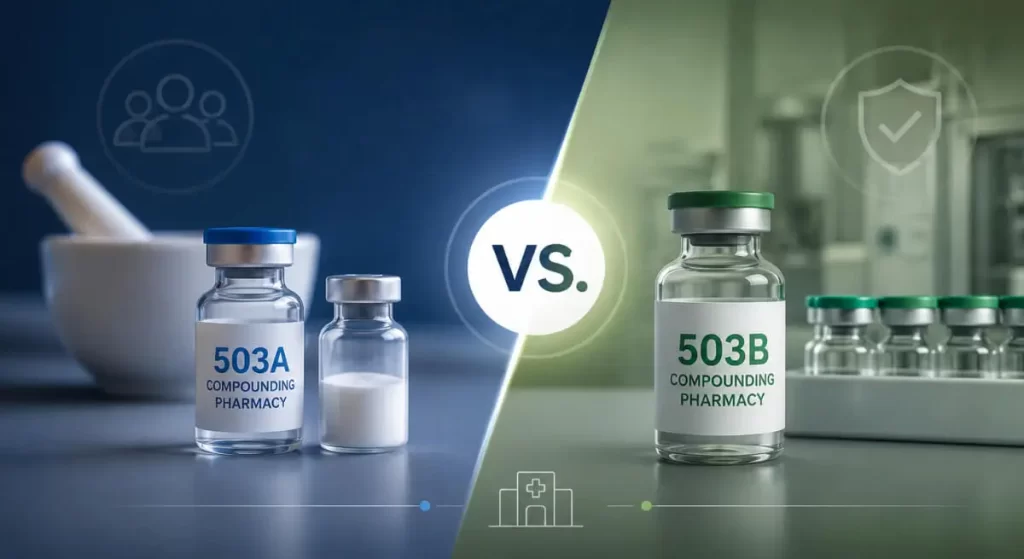
If you run a clinic, the difference between a 503A pharmacy and a 503B outsourcing facility is not trivia. It decides whether you can legally keep compounded medications on your shelf, what paperwork you need, who inspected the facility your medication came from, and what happens if something goes wrong.
We coordinate sourcing between clinics and licensed pharmacies every day, and this question — “what’s the actual difference, and which one do I need?” — comes up more than any other. So here is the full answer.
The Short Version of 503A vs. 503B
A 503A compounding pharmacy prepares a medication for one named patient, based on a valid prescription. It is licensed and primarily overseen by its state board of pharmacy.
A 503B outsourcing facility can compound medications in bulk without patient-specific prescriptions — which is what makes “office use” stock legal. In exchange, it registers with the FDA, follows full current Good Manufacturing Practice (cGMP), gets inspected by FDA on a risk-based schedule, and must report adverse events.
If your clinic wants medication for a specific patient, a 503A pathway works. If your clinic wants medication on hand before you know which patient will receive it, you need a 503B pathway. That single distinction drives almost everything else.
Where These Rules Came From: The DQSA
In 2012, contaminated steroid injections compounded by the New England Compounding Center in Massachusetts caused a multistate fungal meningitis outbreak — more than 750 infections and more than 60 deaths across 20 states, according to FDA. It remains one of the worst pharmaceutical safety failures in modern U.S. history.
Congress responded with the Drug Quality and Security Act (DQSA), enacted November 27, 2013. The DQSA did two big things to the Federal Food, Drug, and Cosmetic Act (FD&C Act):
- It reaffirmed and cleaned up Section 503A, the traditional pharmacy compounding pathway.
- It created a brand-new Section 503B, establishing the voluntary “outsourcing facility” category for compounders willing to operate under FDA manufacturing standards.
One important thing to understand about all compounded drugs, from either type of facility: they are not FDA-approved products. FDA does not review them for safety, effectiveness, or quality before they reach patients. The 503A/503B framework exists to manage that risk — it does not eliminate it. This is exactly why supplier verification matters so much.
Side-by-Side Comparison
| 503A Compounding Pharmacy | 503B Outsourcing Facility | |
|---|---|---|
| Prescription requirement | Patient-specific prescription required | May compound without patient-specific prescriptions |
| Office-use / clinic stock | Not permitted under federal law | Permitted — this is the legal pathway for office stock |
| Primary oversight | State board of pharmacy | FDA (plus state licensure) |
| Manufacturing standard | USP compounding standards (e.g., <795>, <797>) as adopted by states | Full federal cGMP |
| FDA registration | Not registered with FDA as a compounder | Registers with FDA annually, pays establishment fee |
| FDA inspections | Not routine; FDA may inspect for cause | Risk-based FDA inspection schedule |
| Adverse event reporting to FDA | Not required by federal law | Required |
| Product reporting to FDA | Not required | Reports what it compounds to FDA |
| Batch scale | Individual or limited quantities | Bulk batches |
| Typical use case | Personalized dose/formulation for one patient | Clinic stock, hospital stock, standardized preparations |
What a 503A Pharmacy Can and Cannot Do
Section 503A describes the conditions under which compounded drugs are exempt from three big FD&C Act requirements: pre-market FDA approval, cGMP, and standard labeling requirements. The central condition is that compounding happens based on receipt of a valid, patient-specific prescription.
What this means in practice for a clinic:
- You can send a prescription for an individual patient to a 503A pharmacy, and the compounded medication is dispensed for that patient.
- You cannot legally order “20 vials for the clinic fridge” from a 503A pharmacy under federal law. That is distribution without patient-specific prescriptions — the thing 503B was created to handle.
- Quality oversight rests mostly with the state board of pharmacy where the pharmacy is licensed, which is why the state layer matters (see our state-by-state sourcing rules resource).
Some states have their own rules that touch on office-use dispensing, in-office administration, and quantity limits, and they do not always read the same way as federal policy. When state and federal rules seem to conflict, the conservative reading — patient-specific through 503A, office stock through 503B — is the position we see licensed partners take in practice.
What Makes a 503B Different
Registering as an outsourcing facility is voluntary — a compounder chooses to opt into federal oversight. In exchange for the ability to produce bulk batches without prescriptions, a 503B facility:
- Registers with FDA and re-registers every year, with an annual establishment fee
- Operates under full cGMP — the same category of manufacturing standard applied to conventional drug manufacturers
- Is inspected by FDA on a risk-based schedule
- Must report adverse events to FDA
- Must tell FDA what products it compounds
As of FDA’s May 2026 update to its registered outsourcing facilities list, there were only 95 registered 503B outsourcing facilities in the entire United States. That is a small universe. It also means the FDA registry is genuinely checkable: any clinic (or sourcing coordinator) can look up a specific facility, see when FDA last inspected it, whether a Form 483 was issued, and whether any warning letter or recall followed.
That transparency is a feature. Use it.
“Office Use” — the Term That Causes the Most Confusion
“Office use” (sometimes “office stock”) means medication a clinic keeps on hand and administers to patients as needed — before knowing which specific patient will receive which vial.
Under the federal framework:
- 503B outsourcing facilities can supply office-use medication. This is the clean, designed-for-this-purpose pathway.
- 503A pharmacies federally require a patient-specific prescription. A clinic collecting prescriptions per patient and having each filled individually is fine; stocking bulk product from a 503A is not what the federal statute contemplates.
If a supplier offers you bulk compounded stock and cannot clearly show you either (a) an FDA outsourcing facility registration, or (b) a patient-specific dispensing workflow, that is a red flag worth taking seriously.
How to Verify Any Compounding Facility in 10 Minutes
This is the checklist we use in coordination work. Anyone can run it:
- Check the FDA registered outsourcing facilities list. Confirm the facility is on it, and read the inspection columns: last inspection date, Form 483 issued, any warning letter or recall.
- Check the state board of pharmacy license — both in the facility’s home state and, for shipments, whether it holds a nonresident pharmacy license for your state (see our state-by-state sourcing rules).
- Ask for the Certificate of Analysis (CoA) for the specific lot, showing identity, potency, and sterility testing. We covered what a proper CoA looks like in our guide to purity standards in wholesale AOD 9604 sourcing — the same principles apply to any compounded injectable.
- Check FDA’s compounding inspections, recalls, and compliance actions page for the company name — actions sometimes attach to sister facilities under common ownership.
- Confirm DEA registration if any product involved is a controlled substance (for example, testosterone is Schedule III federally).
A legitimate facility will not be offended by any of these questions. In our experience, the good ones answer before you ask.
Which Pathway Does Your Clinic Need?
A rough decision guide:
- Individualized dosing, one patient at a time (e.g., a patient-specific hormone preparation): Its 503A pathway with valid prescriptions.
- Standing clinic stock for in-office administration (e.g., injectables administered during visits): Its 503B pathway.
- Both patterns in one practice: its both. Many clinics maintain 503A relationships for patient-specific scripts and 503B relationships for office stock. This is exactly the fragmentation problem a sourcing coordination layer exists to simplify and here’s how that coordination works in practice, and the injectables and peptides our network covers.
Once your medication arrives, the compliance job isn’t over — see our storage, beyond-use date, and cold-chain receiving reference for what clinic staff should do at the receiving end.
Frequently Asked Questions
Is a 503B “better” than a 503A? Neither is better; they are built for different jobs. A 503A offers patient-level customization under state oversight. A 503B offers bulk, cGMP-manufactured stock under FDA oversight. A quality failure is possible at either — which is why verification beats labels.
Are compounded drugs FDA-approved? No. No compounded drug is FDA-approved, whether it comes from a 503A or a 503B. FDA does not evaluate compounded drugs for safety, effectiveness, or quality before marketing.
Can a facility be both 503A and 503B? A single company can operate both a state-licensed pharmacy and a separately registered outsourcing facility, but the operations and requirements are distinct. Ask which entity is actually filling your order.
How many 503B outsourcing facilities are there? 95 facilities appeared on FDA’s registered outsourcing facilities list as of the May 2026 update. The list changes as facilities register, re-register, or drop off, and FDA updates it weekly.
Does a clinic need a special license to buy from a 503B? Clinics need appropriate state licensure and, for controlled substances, DEA registration. Requirements vary by state — check your state board of pharmacy and medical board, or see our state-by-state sourcing resource.
Who inspects 503A pharmacies? Primarily the state board of pharmacy in the state where the pharmacy is licensed. FDA can inspect a 503A for cause but does not put them on a routine federal inspection schedule the way it does 503B facilities.
References
- FDA — Human Drug Compounding Laws (DQSA, sections 503A and 503B)
- FDA — Registered Outsourcing Facilities (weekly-updated registry)
- FDA — Multistate Outbreak of Fungal Meningitis and Other Infections (2012)
- FDA — Bulk Drug Substances Used in Compounding (503A and 503B lists)
- FDA — Understanding the Risks of Compounded Drugs
- Section 503A of the Federal Food, Drug, and Cosmetic Act (FDA)
Disclaimer:
Phoenix Meds Inc. is a healthcare supply coordination platform. We do not sell, dispense, or manufacture medications. We connect licensed clinics with licensed 503A/503B pharmacies, wholesalers, and distributors. Nothing here is legal or medical advice; consult your state boards and counsel for compliance decisions.