
Imagine you have researched a topic for a project six months ago, and felt totally prepared. But after a few moments or days you realize that the rules have completely changed overnight.
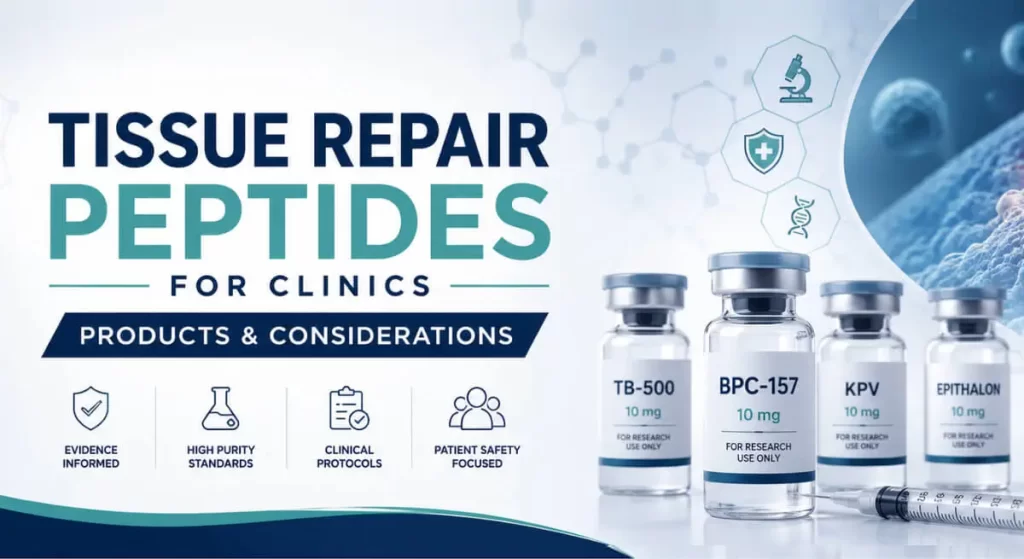
That is exactly what happens to the medical world of tissue repair peptides. On July 23 and 24, 2026, the FDA (the U.S. Food and Drug Administration, which acts like the ultimate referee for medicine safety) held a massive advisory meeting. They voted on whether specialized pharmacies should still be allowed to custom-make (compound) several of these trendy healing peptides. Four of the main peptides we will discuss were on that exact hit list.
So if you run a clinic and you are thinking about using these products—the rulebook you read a few months ago is officially out of date. Therefore let’s break it down what you need to know about tissue repair peptides and its considerations
It covers what each product is, where the FDA genuinely stands as of this writing, what just changed, and what to check before you source anything. None of this is medical advice, and none of it recommends any product for any patient. It is background so your decisions rest on the actual record rather than on whatever a sales rep told you.
What this category actually covers
Tissue repair peptides, sometimes called regenerative peptides for clinics or recovery peptides for clinics, are short chains of amino acids that clinics have looked to in the context of healing, inflammation, and recovery. They are grouped together by intended use rather than by a shared mechanism, which is an important distinction.
That grouping is looser than most marketing suggests. A peptide studied for gut and connective tissue work sits beside one derived from a protein involved in cell movement, beside a small anti-inflammatory fragment, beside a pineal peptide tied to aging research, beside an immune-modulating peptide. They land in the same brochure. They do not share a single pathway or a single evidence base.
Here is the part that matters most for a clinic owner, and I would rather say it plainly at the top than bury it. Not one of the products in this guide holds FDA approval. Every one of them has sat in the FDA’s file of substances with unresolved safety questions. That does not make them illegal to discuss or automatically unavailable, but it does mean this category demands more care, better sourcing, and more honest patient conversations than a category built on approved drugs.
The products, one by one
Each of these deserves its own plain description, along with what the FDA has actually said about it.
BPC-157 and TB-500
BPC-157 is the most recognized name here. The BPC-157 peptide is a synthetic fragment associated with a protein found in gastric juice, and clinics encounter it most often in connective tissue and gut-related contexts. The FDA has stated that compounded drugs containing it may pose immunogenicity risk for certain routes and carry complexities around peptide impurities and characterization, and that the agency has identified only limited safety information for the proposed routes. You can review information on the BPC-157 10 mg page.
TB-500 is the other half of the most common pairing. The TB-500 peptide is a fragment of thymosin beta-4, a protein involved in cell movement and repair processes. The FDA’s assessment is blunt: it has not identified any human exposure data for drug products containing this fragment, so the agency lacks the information needed to know whether it would cause harm. See the TB-500 10 mg peptide page for product details.
Clinics frequently ask about the two together, since suppliers commonly offer a BPC-157 with TB-500 combination. The logic offered for pairing them is that they are associated with different repair-related processes. The evidence base for the combination in humans is thinner than the marketing around it, which is worth keeping in mind when your team fields questions.
KPV, Epithalon, and Thymosin Alpha-1
KPV is a very short fragment, three amino acids, associated with anti-inflammatory activity. The KPV peptide is the one where the FDA’s language is most stark. The agency has stated it has not identified any human exposure data on drug products containing KPV by any route of administration. Product formats appear on the KPV sorucing for clinics page.
Epithalon, which the FDA spells Epitalon, is a four amino acid peptide tied to pineal and longevity research. The Epithalon peptide carries the same pattern of FDA concern: possible immunogenicity risk from aggregation and impurities, with no safety information identified for the proposed route. The Epithalon cooridnation page covers what we help clinics source.
Thymosin Alpha-1 sits slightly apart. The Thymosin Alpha-1 peptide relates to immune modulation rather than structural repair, and it has a longer international research history than the others. The FDA has said the safety information available is inadequate for the agency to understand the extent of any safety issues. Notably, it was not among the peptides reviewed at the recent advisory meeting, so its path remains less clear than its shelf-mates. See the Thymosin Alpha-1 coordination page.
Where each product stands right now
This table reflects the FDA’s public record as of this writing. Treat it as a purchasing and awareness reference, not as clinical guidance, and verify status yourself before you act.
| Product | What it is | FDA status |
|---|---|---|
| BPC-157 | Synthetic gastric protein fragment | Not approved. Nomination withdrawn from Category 2. Recommended by advisory committee in July 2026 |
| TB-500 | Thymosin beta-4 fragment | Not approved. Nomination withdrawn. Recommended by advisory committee in July 2026 |
| KPV | Three amino acid anti-inflammatory fragment | Not approved. Nomination withdrawn. Recommended by advisory committee in July 2026 |
| Epithalon | Four amino acid pineal peptide | Not approved. Nomination withdrawn. Recommended by advisory committee in July 2026 |
| Thymosin Alpha-1 | Immune-modulating peptide | Not approved. Nomination withdrawn. Not included in the July 2026 review |
What actually happened in 2026
Two events reshaped this category, and clinics keep conflating them, so let me separate them cleanly.
First, in April of 2026, the FDA updated its bulk substances lists and moved a group of peptides out of Category 2, the file for substances that may present significant safety risks. That group included BPC-157, TB-500, KPV, and Epitalon. The move followed the withdrawal of their nominations rather than any finding that the substances are safe. The FDA still publishes its specific concerns for each one.
Second, on July 23 and 24 of 2026, the Pharmacy Compounding Advisory Committee met to consider whether seven peptides belonged on the list of substances permitted for compounding under section 503A. The committee recommended six of them, including BPC-157, TB-500, KPV, and Epitalon. One, emideltide, was voted down.
Now the part that matters most, and the part I would want any clinic owner to hear clearly. An advisory committee recommendation is not FDA approval, and it does not by itself change what a pharmacy may lawfully compound. It advises the agency and begins a formal rulemaking process involving a proposed rule, a public comment period, and a final rule. That takes time, and outcomes are not guaranteed. Anyone selling you certainty about this category right now is getting ahead of the record.
Reading the FDA’s safety language honestly
It is tempting to treat the July vote as a green light and move on. The more useful reading is to look at what the FDA actually wrote about these substances, because those concerns have not evaporated.
Two themes repeat across the agency’s entries. The first is immunogenicity, the possibility that a peptide provokes an unwanted immune response, which the FDA ties to aggregation and peptide-related impurities. That concern is directly about product quality, which puts it squarely in your control through sourcing. The second theme is more sobering: for several of these, including KPV and TB-500, the FDA states it has not identified human exposure data at all. That is not a claim of harm. It is an admission of a thin evidence base.
For a clinic, this shapes how you talk, not only what you stock. Honest framing, careful documentation, and prescriber-directed decisions matter more here than in a category where approved labeling answers these questions for you. Overstating the evidence is the fastest way to turn a peptide program into a liability.
More here on the FDA status of BPC-157 and TB-500.
Sourcing carries more weight in this category
In a category without approved labeling, the pharmacy behind the vial becomes your primary quality control. Two vials can share a label and hold very different contents, and here you have no approved reference product to fall back on.
Ask for a certificate of analysis tied to the specific lot you are buying, produced by an accredited third-party lab rather than the seller’s own bench. It should confirm identity, report purity, and include sterility and endotoxin testing for anything injectable. Given that the FDA’s stated concerns center on impurities and aggregation, that testing is not paperwork for its own sake. It speaks directly to the risk the agency named.
Confirm licensing too. Compounded products come from either a 503A pharmacy filling patient-specific prescriptions under state oversight, or a 503B outsourcing facility that registers with the FDA and follows stricter manufacturing standards. Our guide to choosing a reliable injectable supplier walks through the vetting questions, and you can see the range of peptide products for clinics we help source on our injectables and peptide catalog.
Storage protects what sourcing buys
These arrive as lyophilized powder, and they fail quietly rather than obviously, so handling deserves real attention.
Heat, light, moisture, and time do the damage. Keep sealed powder cold, dark, and dry, with refrigeration for near-term stock and freezer storage for longer holds. Once reconstituted, the clock accelerates: refrigerate the vial, protect it from light, write the date on it, and use it within the window your pharmacy specifies. The diluent matters as well, and our guide to bacteriostatic water storage and shelf life covers that choice.
If you already stock regenerative products, our comparison of GHK-Cu versus BPC-157 and TB-500 is a useful companion, since many clinics carry these lines side by side.
Practical guidance for your menu
A few habits will serve you better than any single product decision in this category.
Keep the menu tight. A small set your team can describe accurately beats a broad one nobody can explain. Keep the claims conservative, because the evidence base here is genuinely thinner than the marketing, and truthful promotion is a legal requirement rather than a preference. Keep decisions with prescribers, and keep your documentation matched to your inventory.
Above all, keep checking. This category is actively moving, and the honest answer to most status questions this year is that it depends on the month. You can track the FDA’s own record through its page on bulk drug substances used in compounding, which is where these lists actually live. Building that check into your reorder routine is the single most protective habit available to you.
The rest of this series
These companion guides go deeper on each part of the category:
- BPC-157 versus TB-500, coordination guide for combination protocols
- Epithalon and Thymosin Alpha-1, what clinics should understand about sourcing
- KPV Peptide Guide: FDA Status and Compliance Position
- Storage and handling guide for tissue repair peptides
- Tissue repair peptide profit margin guide for clinics
Frequently asked questions
What are tissue repair peptides?
They are short amino acid chains that clinics encounter in the context of healing, inflammation, and recovery, including BPC-157, TB-500, KPV, Epithalon, and Thymosin Alpha-1. They are grouped by intended use rather than by a shared mechanism, and none of them currently holds FDA approval.
Are BPC-157 and TB-500 FDA approved?
No. Neither holds FDA approval. Both had their compounding nominations withdrawn from the FDA’s Category 2 list in April 2026, and both received a favorable advisory committee recommendation in July 2026. A recommendation is not approval, and formal rulemaking must follow before anything changes.
What did the July 2026 advisory committee vote actually mean?
The Pharmacy Compounding Advisory Committee recommended six of seven peptides for the section 503A list, including BPC-157, TB-500, KPV, and Epitalon. The vote advises the FDA and starts a rulemaking process with a proposed rule and public comment. It does not by itself authorize compounding or approve any product.
Why does the FDA list safety concerns for these peptides?
Its published concerns center on immunogenicity linked to aggregation and peptide impurities, and on a lack of human exposure data for several substances, including KPV and TB-500. Those are statements about limited evidence and product quality rather than findings of harm, which is why sourcing and documentation matter so much here.
How should a clinic evaluate a supplier for these products?
Ask for a batch-specific certificate of analysis from a third-party lab showing identity, purity, sterility, and endotoxin testing, and confirm whether the product comes from a licensed 503A pharmacy or an FDA-registered 503B facility. Generic paperwork and vague answers about the source are reasons to slow down.
Disclaimer:
This guide is generally for licensed clinics and healthcare professionals reviewing specialty injectable peptides and clinic peptide resources for their product menu. It is not medical or legal advice, it is not a treatment recommendation, and it is not a claim that any product here is safe, effective, or appropriate for any use. None of the products discussed holds FDA approval. The regulatory status of these substances is actively changing, and the details above reflect the public record as of late July 2026. Please verify current FDA and state rules before acting, keep all patient communication and marketing truthful, rely on qualified prescribers for clinical decisions, and source only through properly licensed pharmacies and wholesalers.