
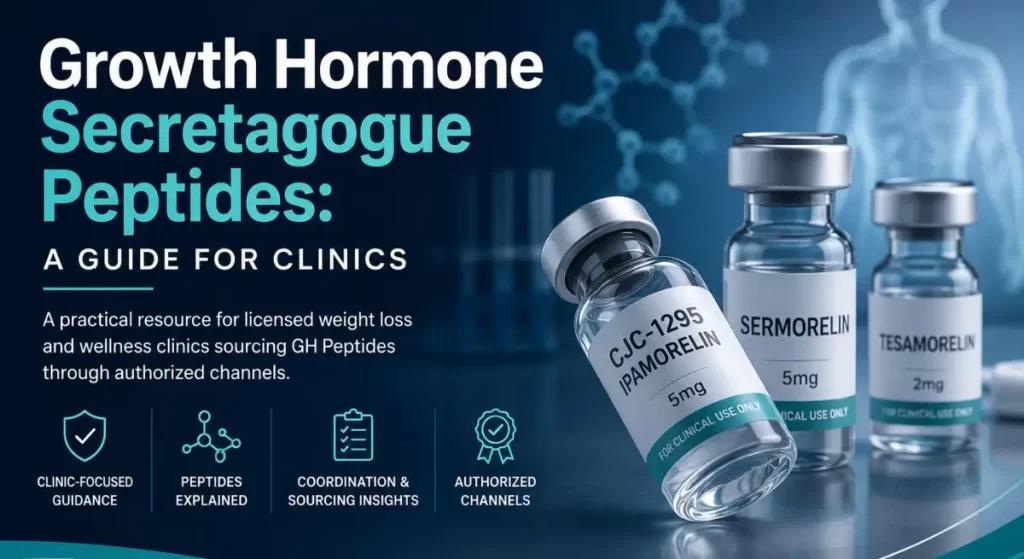
If you run a weight loss clinic or a functional wellness practice, chances are you have heard the term “growth hormone secretagogue” come up more and more over the last few years. Maybe a patient asked about Sermorelin. Maybe another clinic in your area started offering CJC-1295 and you are wondering what that even means for your practice. Or maybe you have been curious but honestly did not know where to start.
That is exactly why this guide exists. It is a practical resource for licensed weight loss and wellness clinics sourcing GH peptides through authorized channels.
At Phoenix Meds Inc. we have spent a whole lot of time in the coordination and sourcing side of the peptide space. Therefore we would like to discuss here what GH secretagogue peptides are, how they work, which ones are most relevant for clinics today, and what you need to think about before sourcing them.
So, let’s get into it.
What Even Is a Growth Hormone Secretagogue?
Here is the simplest way to understand it.
Your body naturally produces growth hormone (GH) through the pituitary gland. As people age, that production declines. A growth hormone secretagogue is a compound that signals your body to produce and release more of its own growth hormone. It is not the same as injecting synthetic growth hormone directly.
Think of it like this. If your gas tank is low, injecting synthetic GH is like pouring gas from a can directly into the engine. A secretagogue, on the other hand, is like pressing the accelerator to get your own engine to generate more power on its own.
That distinction matters a lot, both clinically and from a regulatory and sourcing standpoint.
GH secretagogue peptides work through two main pathways.
First, there are GHRH analogs. These mimic growth hormone releasing hormone, which naturally tells the pituitary to release GH. Sermorelin, CJC-1295, and Tesamorelin fall into this category.
Second, there are GHRPs or growth hormone releasing peptides. These work through a different receptor (the ghrelin receptor) and also stimulate GH release. Ipamorelin is the most commonly discussed one in clinical settings right now.
Many clinics use a combination of both pathways, which is why you often see protocols like CJC-1295 plus Ipamorelin used together.
The Compound Your Clinic Is Most Likely to Encounter
Let us walk through the key players, one by one.
Sermorelin
Sermorelin is arguably where most clinics start their education on this topic. The FDA approved it (Geref) for pediatric GH deficiency, though the manufacturer later discontinued that brand. Today, licensed pharmacies commonly compound it, and some physicians prescribe it for adult body-composition and sleep-related goals. Clinics coordinating Sermorelin sourcing typically work through verified pharmacy partners.
It has a shorter half-life compared to some newer peptides, which means it mimics the natural pulsatile release of GH more closely. Many clinicians and coordinators consider this a gentle starting point for patients new to peptide therapy.
For a deeper look at how clinics are approaching Sermorelin coordination, check out our guide on CJC-1295 + Ipamorelin vs. Sermorelin: Coordination Considerations for Clinics.
CJC-1295
CJC-1295 is a modified GHRH analog with a significantly longer half-life than Sermorelin. The version with DAC (Drug Affinity Complex) can stay active in the bloodstream for days, while the version without DAC (also known as Mod GRF 1-29) has a shorter activity window. For clinics, understanding this distinction matters when discussing protocols with prescribing physicians.
Ipamorelin
Ipamorelin is a GHRP that is known for being selective. It stimulates GH release without significantly spiking cortisol or prolactin, which makes it a popular pairing with CJC-1295 in clinical protocols. It is generally well tolerated and is one of the most requested peptides in weight loss clinic settings right now.
The CJC-1295 + Ipamorelin coordination piece is something we help clinics navigate regularly, particularly around sourcing, documentation, and storage requirements.
Tesamorelin
Tesamorelin is unique in this list because it is the only FDA-approved growth hormone releasing hormone analog for lipodystrophy in HIV-positive patients (brand name Egrifta). However, compounded tesamorelin preparations also circulate for uses outside the approved indication; eligibility for those preparations must be verified separately. Clinics comparing options here may also find our AOD 9604 vs Tesamorelin and Ipamorelin comparison useful. Tesamorelin sourcing for clinics is coordinated through authorized channels.
Somatropin: The Direct GH Alternative
Somatropin is worth mentioning here precisely because it is not a secretagogue. It is synthetic growth hormone itself, supplied directly rather than signaling your body to make more of its own. It is FDA-approved for specific diagnosed conditions and sits under tighter regulatory oversight than anything else on this list. Clinics weighing the two approaches will want to read our article on Tesamorelin vs. Somatropin: What Clinics Should Know Before Sourcing.
A Quick Comparison Table
| Compound | Type | Half-Life | Notable Feature | Current Status |
|---|---|---|---|---|
| Sermorelin | GHRH analog | Short (minutes) | Mimics natural GH pulse | Compounded |
| CJC-1295 with DAC | GHRH analog | Long (days) | Sustained GH elevation | Compounded |
| CJC-1295 without DAC | GHRH analog | Medium (30 min) | More natural pulse rhythm | Compounded |
| Ipamorelin | GHRP | Short | Selective, low cortisol spike | Compounded |
| Tesamorelin | GHRH analog | Medium | Only FDA-approved GHRH analog | FDA-approved + Compounded |
| Somatropin | Synthetic GH | Varies | Direct GH, not a secretagogue | FDA-approved |
Why Clinics Need a Coordinated Sourcing Approach
Here is where a lot of clinics run into trouble. They know they want to offer these peptides. They know patients are asking for them. But the sourcing side of things can get complicated fast.
Compounded peptides are not FDA-approved in the same way that commercially manufactured drugs are. That does not mean they are illegal or unsafe. It means each substance’s compounding eligibility must be verified first – pharmacy type, prescribing, and documentation address different questions.
The difference between a 503A pharmacy and a 503B facility matters. A 503A pharmacy compounds on a patient-specific, prescription basis. A 503B outsourcing facility can produce larger batches for office use without patient-specific prescriptions, but they are subject to FDA oversight and cGMP (Current Good Manufacturing Practice) standards.
Getting this wrong is not just a compliance risk. It can put your clinic’s license and your patients at risk.
That is exactly the kind of coordination gap that Phoenix Meds Inc. helps clinics close. We work to connect licensed clinics with authorized pharmacies and wholesalers who meet documentation and purity standards. If you are still evaluating partners, our guide on choosing a reliable medical injectable supplier covers the questions worth asking upfront, and our post on Sourcing GH Peptides: Purity Standards and Documentation for Clinics goes deeper on what to verify before you commit.
Explore our complete range of injectable therapies and peptides through our clinic-focused medication sourcing coordination platform.
Storage and Handling: Do Not Skip This Part
One thing that many clinics underestimate when they first start offering injectable peptides is how sensitive these compounds are.
GH secretagogue peptides are fragile. Temperature matters enormously. Therefore clinics should store most peptides under refrigeration. Manufacturers provide some as lyophilized (freeze-dried) powder that clinic staff must reconstitute with bacteriostatic water before use. Improper storage can degrade the peptide before it ever reaches a patient, which wastes money and potentially harms outcomes.
Your clinic staff needs a clear protocol. Your storage equipment needs to be reliable. And your receiving process needs to include documentation checks.
We have put together a full breakdown of this in our Storage & Handling Guide for GH Secretagogue Peptides, which is a must-read for clinic administrators before they go live with any peptide program.
The Business Side: What Does This Look Like for Your Practice?
Let us be real for a second. Clinics are businesses. You care about patient outcomes and you also need to know whether adding a peptide program makes financial sense.
The good news is that GH secretagogue programs can complement existing services in weight loss and wellness clinics, particularly when offered alongside GLP-1 programs or medically supervised weight management. The margin on compounded injectables, when sourced correctly through authorized channels, can be meaningful.
But there is a right way and a wrong way to do this. Clinics that cut corners on sourcing to chase margin end up with compliance headaches, patient complaints, and potentially serious regulatory consequences.
If you want a clear-eyed look at the numbers, our GH Secretagogue Profit Margin and ROI Guide for Clinics walks through realistic cost structures, patient pricing models, and what to watch out for.
Frequently Asked Questions (FAQ)
What is a growth hormone secretagogue peptide?
A growth hormone secretagogue peptide is a compound that stimulates the body to produce and release its own growth hormone naturally. It works by signaling the pituitary gland through specific hormone receptor pathways. Examples include Sermorelin, CJC-1295, Ipamorelin, and Tesamorelin.
Is Sermorelin FDA-approved?
The FDA previously approved Sermorelin under the brand name Geref for pediatric use, but the manufacturer later discontinued the product. Today, Sermorelin for adults is most commonly available through licensed compounding pharmacies with a valid prescription from a licensed physician.
What is the difference between CJC-1295 with DAC and without DAC?
CJC-1295 with DAC has a Drug Affinity Complex that extends its half-life to several days, providing more sustained GH elevation. CJC-1295 without DAC, also called Mod GRF 1-29, has a shorter half-life and more closely mirrors the body’s natural pulsatile release of GH.
Can any clinic source GH secretagogue peptides?
Clinics must have a licensed prescribing physician on staff and maintain proper documentation. Sourcing from unauthorized or unverified suppliers is a compliance and safety risk.
Why is Ipamorelin usually combined with CJC-1295?
They work through different receptor pathways, and using them together creates a synergistic effect on GH release. CJC-1295 stimulates GHRH receptors while Ipamorelin stimulates ghrelin receptors. Together they can produce a stronger, more sustained GH pulse than either would alone.
What should clinics look for when choosing a pharmacy partner for GH peptides?
Look for pharmacies with 503A or 503B status, clear COA (Certificate of Analysis) documentation, third-party testing records, proper licensing in your state, and responsive communication. Avoid any supplier that cannot provide full documentation on demand.
How should GH secretagogue peptides be stored?
Clinics should keep most GH peptides refrigerated between 2 and 8 degrees Celsius. Lyophilized (freeze-dried) powder should be stored away from light and moisture. Once reconstituted, they typically need to be used within a specific window, usually 14 to 30 days, depending on the compound and pharmacy labeling instructions.
Does Phoenix Meds Inc. sell or dispense peptides directly?
No. Phoenix Meds Inc. is a coordination platform. We connect licensed clinics with authorized pharmacies and wholesalers. We do not manufacture, dispense, compound, or prescribe any medications.
Final Thoughts
Growth hormone secretagogue peptides are not a trend. They are a growing part of what patients are asking for, and what forward-thinking clinics are learning to offer responsibly.
The key word there is responsibly. That means sourcing through the right channels, working with licensed prescribers, training your staff on handling and storage, and keeping documentation airtight.
If your clinic is exploring GH secretagogue peptides for the first time, or if you are already offering them and want to tighten up your process, Phoenix Meds Inc. offers the coordination platform to bridge the gap between your practice and the right pharmacy partners.
Source GH secretagogue peptides for your clinic
Disclaimer:
This content is intended for educational purposes and is directed toward licensed healthcare professionals and clinic administrators. Phoenix Meds Inc. does not provide medical advice and does not prescribe or dispense medications. Licensed physicians should make all clinical decisions in compliance with applicable laws and regulations.
Related Resources:
CJC-1295 + Ipamorelin vs. Sermorelin: Considerations for Clinics
Tesamorelin vs. Somatropin: What Clinics Should Know
Storage and Handling Guide for Growth Hormone Secretagogue Peptides
Sourcing Growth Hormone Peptides: Purity Standards and Documentation for Clinics
Growth Hormone Secretagogue Profit Margin & ROI Guide for Clinics