
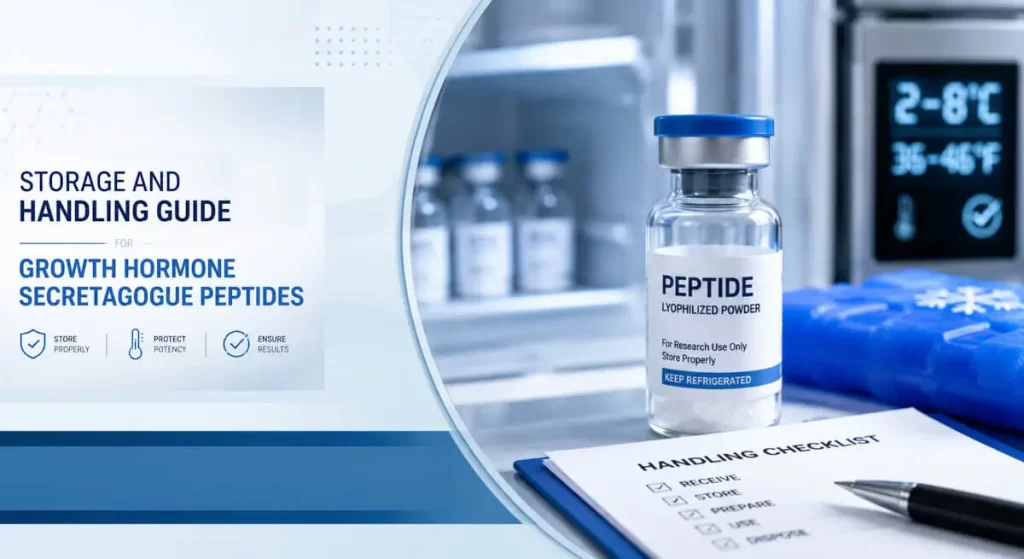
A ruined vial almost never announces itself. It looks fine, it draws up fine, and you only find out something went wrong when a batch quietly underperforms or a patient asks why this month felt different. That is the frustrating thing about peptides. They fail silently, and by the time you notice, the money is already in the sharps bin.
So let us walk you through a practical storage and handling guide for growth hormone secretagogue peptides. This is a general peptide storage guide for your operations team, not medical advice, and it does not replace the specific instructions on each product’s label. When your product labeling says something different from a general rule below, the label wins every time.
The four things that wreck peptides
Before we get product by product, it helps to know what you are actually protecting against. Four enemies do most of the damage.
Heat comes first. Warmth speeds up the chemical reactions that break peptide bonds, so a vial left on a warm counter ages fast. Light is next. Sunlight and even bright fluorescent office lighting can oxidize sensitive parts of the molecule, which is why amber vials and closed drawers matter. Moisture is the third. A lyophilized, or freeze-dried, powder wants to stay bone dry, so humidity and condensation are the enemy. Time is the quiet fourth. Even under perfect conditions, a reconstituted vial has a clock running on it.
Keep those four in mind and most good handling habits start to feel obvious. Cold, dark, dry, and fresh is the whole philosophy in four words. A helpful way to picture it: a peptide is a little like fresh fish. In the freezer it keeps for a long time, in the fridge it has a good but limited run, and left on the counter it turns fast. Nobody argues with that logic for dinner, and the same instinct serves you well at the med fridge.
Storing the powder before you mix it
Most of these products arrive as a lyophilized powder, and in that dry state they are surprisingly tough, as long as you keep them cold and dark.
For everyday clinic use, a refrigerator set between 2 and 8 degrees Celsius, which is roughly 36 to 46 degrees Fahrenheit, handles short-term storage well. If you are holding stock for the longer haul, do not freeze a preparation or extend its dating unless the exact manufacturer’s or dispensing pharmacy’s instructions explicitly permit it. Lyophilized products do not share a universal freezer-storage rule. Keep the vials in their original packaging, away from light, and away from the fridge door where the temperature swings every time someone grabs a snack.
Good peptide product storage also means guarding against moisture. Do not let vials sit out and sweat as they warm up, and do not open a cold vial in a humid room without letting it settle. These small habits protect the powder from the condensation that shortens its life.
Here is a habit that pays for itself. The moment a shipment arrives, decide then and there which vials go to the freezer for the coming weeks and which stay in the fridge for this week’s appointments. Sorting stock on arrival, rather than tossing everything into one cold drawer, means your long-term supply sits at freezer temperature from day one and your active vials stay easy to reach. It takes five minutes and it quietly extends the life of everything you just paid for.
After you reconstitute, the clock starts
The moment you add liquid, the rules tighten. A reconstituted peptide is far more fragile than the powder it came from, and it will not last on the shelf.
Store the mixed vial in the refrigerator between 2 and 8 degrees Celsius, and protect it from light. What you reconstitute with matters, too. Bacteriostatic water contains a preservative that holds back bacterial growth, so bacteriostatic water does not establish a preparation’s usable life. The permitted diluent, storage conditions, and in-use period depend on the exact product or compounded formulation, depending on the peptide and the manufacturer’s guidance. Sterile water has no preservative, so anything mixed with it should be used right away and the rest discarded. Our guide to bacteriostatic water storage and shelf life digs into that choice in more detail.
Two habits save a lot of grief here. First, label every reconstituted vial with the date you mixed it and the date it expires, so nobody has to guess. Second, do not freeze a reconstituted vial unless the label specifically allows it, because freezing and thawing can damage the very molecule you are trying to protect.
A quick product-by-product view
The general rules cover most of it, but a few specifics help. This table is a starting reference for GH peptide handling, not a substitute for each product’s own labeling.
| Product | Powder storage | After reconstitution |
|---|---|---|
| CJC-1295 with Ipamorelin | Fridge 2 to 8 degrees Celsius short term, freezer for long term, kept dark and dry | Refrigerate and protect from light, used within the beyond-use date on the specific pharmacy label |
| Sermorelin | Same cold, dark, dry approach as other lyophilized peptides | Refrigerate and use within the window the compounding pharmacy specifies |
| Tesamorelin | Follow the approved product labeling, refrigerated and protected from light | Refrigerate and follow the label, since the branded product gives exact figures |
| Somatropin | FDA labeling directs storage between 2 and 8 degrees Celsius, do not freeze | Keep refrigerated, protect from light, and follow the product’s dated in-use window |
For CJC-1295 storage and Sermorelin storage, the compounding pharmacy’s paperwork is your source of truth, because compounded products do not carry standardized FDA labeling the way branded drugs do. You can review formats on the CJC-1295 with Ipamorelin blend page and the Sermorelin 10 mg coordination page, then match your handling to whatever the pharmacy specifies.
For Tesamorelin storage and Somatropin storage, you have something even better, real FDA-approved labeling with exact numbers printed right on it. You can learn how to read the storage section of any approved label (e.g., Egrifta’s approved tesamorelin) through the FDA labeling resources for prescription drugs but not every preparation are sold under that name. When a compounded vial and an approved vial share the same fridge, give both the same care, but always lean on the printed label when you have one.

Handling and inventory in a busy clinic
Storage is only half the job. How your team handles and tracks these products decides whether your careful cold chain actually holds.
Start at the loading dock. When a shipment lands, check it right away and confirm any cold packs are still cold. A vial that spent a hot afternoon on a porch is a question mark, and it is far cheaper to flag it on arrival than to inject a guess. Good suppliers ship with the cold chain in mind, which is one more reason sourcing matters. Our notes on what to look for in a reliable injectable supplier cover shipping and documentation together.
Inside the clinic, a little clinic peptide inventory management goes a long way. Rotate stock so the oldest vials get used first, keep a simple log of what is in the fridge and when it expires, and put a thermometer in that fridge with someone responsible for reading it. A cheap temperature alarm and a plan for power outages protect a surprising amount of value. Our clinic guide to growth hormone secretagogue peptides shows how the whole category fits together.
The same care applies across every product in our peptide sourcing catalog, from compounded blends to FDAapproved vials.
Storage is a margin decision, not just a clinical one
It is easy to file storage under clinical housekeeping, but it lands squarely on your bottom line. Every vial that spoils is money you already spent, and specialty injectables are not cheap. A single fridge left unplugged over a long weekend can erase a chunk of a month’s inventory, and nobody notices until the next patient visit.
Flip that around and storage becomes one of the cheapest safeguards you have. A reliable refrigerator, a thermometer, a simple log, and a habit of dating vials cost almost nothing next to the product they protect. When you think of your fridge as a piece of revenue equipment rather than a break-room appliance, the small daily habits stop feeling like chores and start feeling like insurance. That mindset also reassures patients, who trust a clinic that clearly runs a tight, careful operation.
The short version
If you remember nothing else, remember cold, dark, dry, and dated. Keep the powder cold and away from light and moisture, refrigerate what you reconstitute, protect it from light, and write the expiration date right on the vial. Follow each product’s labeling for the exact numbers, especially for the FDA-approved products, and treat your fridge like the important piece of equipment it is. Do that, and you protect both your patients and your margins.
Frequently asked questions
What is the simplest storage and handling guide for growth hormone secretagogue peptides?
Keep the lyophilized powder cold, dark, and dry, using a refrigerator for short-term storage and a freezer for long-term stock. After you reconstitute, refrigerate the vial, protect it from light, label the date, and use it within the window the label or pharmacy specifies. Always follow the specific product labeling. However, do not freeze or extend dating unless the specific pharmacy’s instructions explicitly permit it.
Do these peptides need to be refrigerated?
Yes, in almost every case. Both the powder and the reconstituted solution do best refrigerated between 2 and 8 degrees Celsius. Somatropin’s FDA labeling specifically directs refrigerated storage and says not to freeze, and the same cold, dark approach protects CJC-1295, Sermorelin, and Tesamorelin.
How long does a reconstituted vial last?
It depends on the diluent and the product. Vials mixed with bacteriostatic water often stay usable for about 14 to 28 days under refrigeration, while sterile water mixtures should be used right away. The product label gives the exact in-use window, so follow it rather than a general rule.
Can I freeze a reconstituted peptide?
Usually no. Freezing and thawing can damage a reconstituted peptide, and products like Somatropin are labeled not to freeze. Freeze only if the specific label allows it, and never assume it is fine.
What is the biggest handling mistake clinics make?
Losing track of time and temperature. An unlabeled vial, a fridge nobody monitors, or a shipment left unchecked on arrival can quietly waste good product. Simple habits, dating vials, logging inventory, and watching fridge temperature, prevent most of it.
Disclaimer
This article is general educational information about storage and handling for licensed clinics and healthcare professionals. It is not medical advice, it is not a dosing or treatment recommendation, and it does not replace the manufacturer or compounding pharmacy labeling for any specific product. Always follow the approved product labeling and your pharmacy’s instructions, confirm current FDA and state rules, and rely on qualified professionals for clinical and handling decisions.
Related Resources:
Growth Hormone Secretagogue Peptides: A Guide for Clinics
CJC-1295 + Ipamorelin vs. Sermorelin: Considerations for Clinics
Tesamorelin vs. Somatropin: What Clinics Should Know
Sourcing Growth Hormone Peptides: Purity Standards and Documentation for Clinics
Growth Hormone Secretagogue Profit Margin & ROI Guide for Clinics